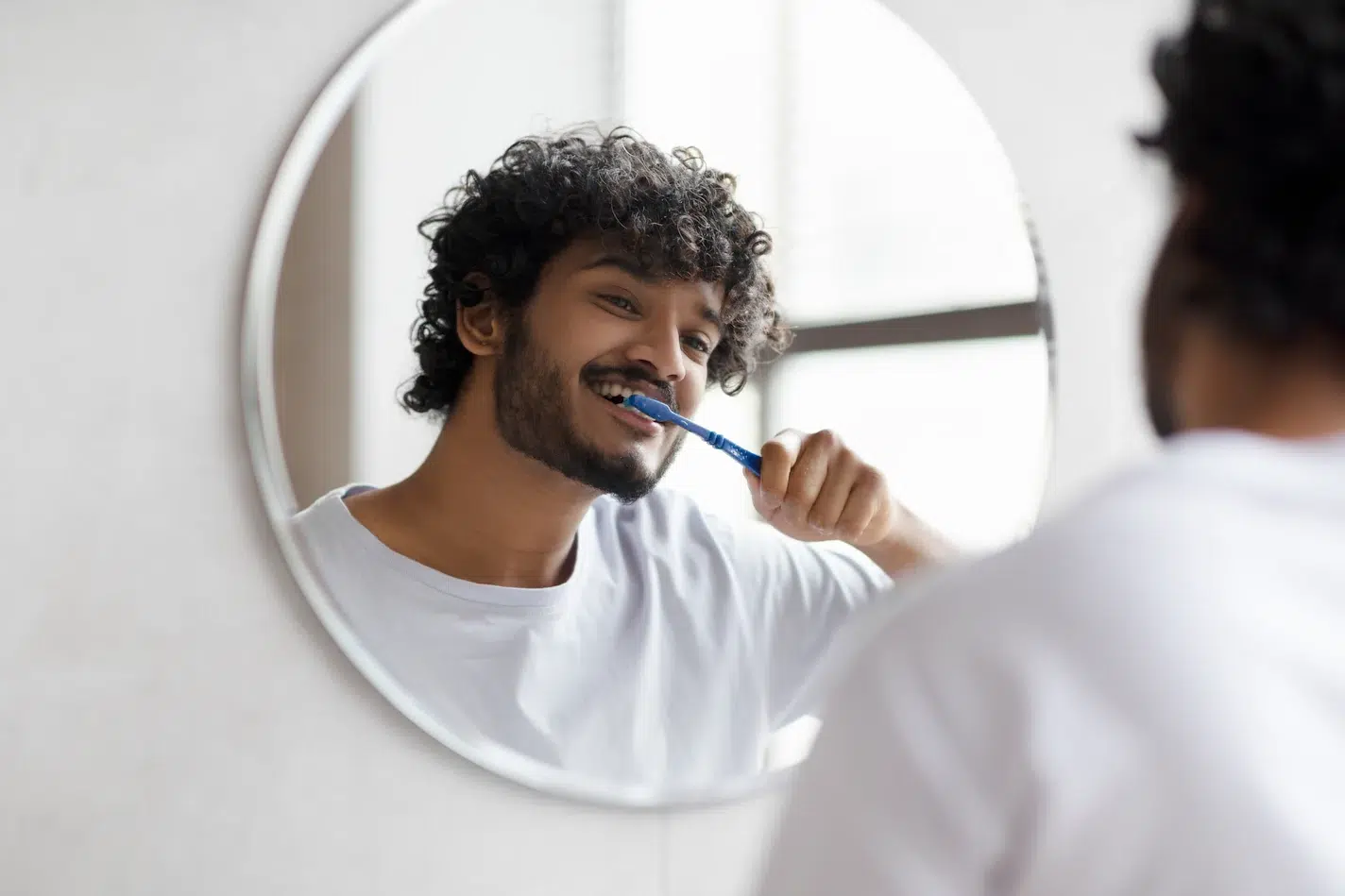
Hand on heart: when did you last think about the environment while brushing your teeth? If you have to stop and think, you’re in good company. Brushing is something we do on autopilot, half asleep in the morning and just before bed at night. Yet we reach for a toothbrush, toothpaste and floss at least twice a day, every day of our lives, and that really adds up. If everyone swapped their toothbrush as often as recommended, roughly every two months, Austria alone would bin well over 55 million toothbrushes a year. In Germany, it would be around 500 million [1]. Add to that countless toothpaste tubes and rolls of floss, and plastic, as we all know, sticks around for a very long time.
The good news? Caring for your teeth sustainably doesn’t mean giving up fresh breath or healthy teeth. I’ll show you why good oral care matters so much, how tooth decay actually develops, and 8 simple tips to do something good for your teeth and the planet at the same time.
Why good oral care matters so much
Our teeth work hard every single day: chewing, biting, coping with hot tea and ice-cold ice cream. And your mouth isn’t a closed system. Bacteria from your mouth can contribute to inflammation throughout the body [2]. So oral care is about far more than a pretty smile. It’s genuine health care.
How does tooth decay actually happen?
A thin film called plaque is constantly forming on your teeth, and it’s full of bacteria that love sugar. Here’s the thing: it isn’t the bacteria themselves that damage your teeth, but the acids they produce when they feast on sugar. Bit by bit, these acids dissolve minerals from your tooth enamel [3].
Luckily, your body has a built-in repair service: saliva. It neutralises the acids and puts minerals back into the enamel. Trouble only starts when you snack throughout the day or sip sugary drinks. Then your saliva can’t keep up with the repairs, and a hole slowly forms in the tooth [3]. The sneaky part is that tooth decay doesn’t hurt at first. At most, it shows up as small white or brownish spots [4], so you often don’t notice anything for a long time.
What conventional oral care does to the environment
The classic plastic toothbrush is a throwaway product that can’t be recycled. Then there are toothpaste tubes, plastic floss and those little single-use floss picks that sometimes even wash up on beaches. Thankfully, a lot has changed when it comes to microplastics. The tiny plastic scrubbing beads have been banned EU-wide in toothpaste and other rinse-off products since 2023. Other synthetic plastics, however, are still allowed until 2027 [5]. So it’s still worth checking the ingredients list.


8 tips for sustainable oral care
1. Try oil pulling with a tooth oil
Oil pulling comes from Ayurveda and is one of my favourite morning rituals. You put a teaspoon of oil in your mouth, swish it between your teeth for a few minutes and then spit it out. Ideally, spit it into the bin rather than the sink. Your drains will thank you.
My absolute favourite for this is the RINGANA FRESH tooth oil. It’s based on cold-pressed organic sesame oil and packed with plant power: mint, turmeric, clove, myrrh, manuka and eucalyptus oil. It also contains xylitol, which decay-causing bacteria simply can’t use [6]. And the feeling afterwards? Incredibly fresh and clean!
To be honest with you: oil pulling can reduce the bacteria in your mouth [7], but it doesn’t replace brushing [8]. Think of it as a little bonus ritual that rounds off your routine beautifully. Which brings us neatly to the next step: toothpaste.
2. Follow up with a natural toothpaste containing fluoride
After oil pulling, it’s time for the toothbrush, and with it the question: which toothpaste? Many of us deliberately avoid fluoride in natural cosmetics. When it comes to toothpaste, though, it’s worth taking a second look. Fluoride strengthens tooth enamel and has been shown to protect it from decay [4].
That’s why my perfect partner for the tooth oil is the RINGANA FRESH tooth balm. It combines natural care with what really works:
- Sodium fluoride protects your teeth from decay.
- Xylitol, a sugar substitute, more or less starves decay-causing bacteria.
- Prebiotic ingredients support a balanced oral flora.
- Goldenrod, mint and ginger leave your mouth feeling fresh.
The balm doesn’t foam and has a pleasantly subtle flavour, without that overpowering minty hit. My tip: use it after oil pulling in the morning, and on its own in the evening. The two really are a dream team!
3. Treat yourself to a plastic-free toothbrush
Toothbrushes made of bamboo or locally grown wood are now available in almost every chemist. You’ll find a lovely selection here, for example. With wooden brushes, it’s worth looking out for the FSC label. The bristles are usually still made of nylon, but you’ll save a huge amount of plastic all the same. Even better for the environment are toothbrushes with replaceable heads, like these ones. You only swap the head, and the handle lasts for years. Electric toothbrushes, by the way, have the worst environmental footprint [9].
Whichever you choose, replace your toothbrush at least every two months, and always after a cold [10]. Fun fact: almost half of us Austrians don’t change our toothbrush regularly at all [15]. Maybe today’s a good day to do it? There’s no need to throw your old brush away straight away, either. It’s perfect for cleaning the grout in your bathroom.
“
Die größte Gefahr für unseren Planeten ist der Glaube, dass schon jemand anderes ihn retten wird.
Robert Swan
4. Don’t forget the gaps between your teeth
Did you know that your toothbrush only reaches about two thirds of your tooth surfaces [11]? The rest hides between your teeth, and that’s exactly where decay likes to develop unnoticed. There are some great sustainable options for cleaning between your teeth:
- Vegan floss made from corn fibre and candelilla wax even comes in a refillable glass jar, like this one. But watch out: many “natural” flosses are made from real silk, which means they aren’t vegan!
- Interdental brushes with bamboo handles come in different sizes, for example this set with four sizes. Ask your dentist which size is right for you.
5. Give your tongue some attention
Lots of bacteria collect on your tongue, and they’re often behind bad breath. A tongue scraper made of stainless steel or cooper lasts practically forever. Just draw it gently from back to front a few times each morning, rinse, done. It sounds odd, but it feels really good!
6. Turn off the tap
It sounds obvious, but it makes a real difference. A standard tap runs at around 10 litres per minute [12]. If you leave it running while you brush, 20 litres of drinking water can easily go down the drain in two minutes, and that’s twice a day. With a nice tooth mug, you’ll save thousands of litres a year. Remind your kids or housemates too.
7. Eat in a tooth-friendly way
This is where we vegans often have a bit of a head start. Crunchy veg like carrots, celery or apples gets your saliva flowing as you chew, which helps your teeth repair themselves. What matters more than whether you eat sweets is how often. Better to enjoy one slice of cake properly than to nibble on a few gummy bears here and there all afternoon [3].
One more little trick: after fruit, juice or fruit tea, it’s best to wait half an hour before brushing. Otherwise, you’ll scrub away the enamel the acid has just softened [13].

8. See your dentist, even when nothing hurts
Even the best care at home can’t replace a professional’s eye. As a rule of thumb: have a check-up twice a year, ideally with a professional clean from a dental hygienist [10]. If your teeth are in great shape, an individual schedule may be enough [14]. Just ask your dentist what’s right for you. Since tooth decay doesn’t hurt at first, this often saves you bigger (and pricier) treatments down the line.
My sustainable oral care routine at a glance
Morning: scrape your tongue → oil pulling with the FRESH tooth oil → brush with the FRESH tooth balm
Evening: clean between your teeth → brush with the FRESH tooth balm
Twice a year: dental check-up
Conclusion: small steps, big smile
Sustainable oral care isn’t about going without. It’s a little daily ritual that feels genuinely good. And you don’t have to change everything at once. Just start with one tip, for example when your current toothbrush or toothpaste runs out. Your teeth, your gums and our planet will thank you for it.
Fancy trying the dream team for fresh, healthy teeth yourself?
👉 Discover the FRESH tooth oil
👉 And the FRESH tooth balm
Tell me in the comments: which tip do you already follow, and which one would you like to try next?
This text is not a substitute for professional medical advice, diagnosis or treatment. It must not be used as a basis for self-diagnosis or for starting, changing or discontinuing medical treatment. Always consult a qualified healthcare professional if you have any health concerns or symptoms. Greentrinsic accepts no liability for any discomfort or harm arising from the use of the information provided.
Sources:
1. Eigene Berechnung auf Basis der Bevölkerungszahlen (6 Zahnbürsten pro Person und Jahr): Statistik Austria – Bevölkerung zum 1.1.2026 (9,22 Mio.), (https://www.statistik.at/fileadmin/announcement/2026/02/20260209Bevoelkerung1.1.2026.pdf ·) Statistisches Bundesamt – Bevölkerung Ende 2025 (83,5 Mio.), (https://www.destatis.de/DE/Presse/Pressemitteilungen/2026/01/PD26_032_124.html)
2. Österreichische Sozialversicherung – Schulen für Gesundheitskompetenz, (https://www.sozialversicherung.at/cdscontent/load?contentid=10008.783273&version=1701081765)
3. KZBV – Wie entsteht Karies?, (https://www.kzbv.de/patienten/medizinische-infos/karies-und-fuellungen/wie-entsteht-karies/)
4. Gesundheitsportal – Karies, (https://www.gesundheit.gv.at/krankheiten/zaehne/zahnkrankheiten/karies-was-ist-das.html)
5. Verbraucherzentrale – Mikroplastik in Kosmetik, (https://www.verbraucherzentrale.de/wissen/umwelt-haushalt/produkte/mikroplastik-und-kunststoffe-in-kosmetik-und-im-meer-26381)
6. Codecheck – Inhaltsstoffe FRESH tooth oil, (https://www.codecheck.info/p/kosmetik/mund-zahnpflege/mundwasser-spuelungen/ringana-fresh-tooth-oil.html)
7. Meta-Analyse zum Ölziehen (2022), Healthcare, (https://doi.org/10.3390/healthcare10101991)
8. Jong et al. (2023), International Journal of Dental Hygiene, (https://onlinelibrary.wiley.com/doi/10.1111/idh.12725)
9. BUND Hessen – Wie umweltfreundlich ist welche Zahnbürste?, (https://www.bund-hessen.de/tipps/detail/tip/wie-umweltfreundlich-ist-welche-zahnbuerste/)
10. Gesundheitsportal – Zahngesundheit, (https://www.gesundheit.gv.at/krankheiten/zaehne/zahngesundheit.html)
11. Barmer – Zahnpflege, (https://www.barmer.de/gesundheit-verstehen/koerper/zahn/zahnpflege-1054732)
12. energieverbraucher.de – Wasserhahn besser ausnutzen, (https://www.energieverbraucher.de/de/tipp57-wasserdruck__2030/)
13. apotheken.de – Das 1 x 1 der guten Zahnpflege, (https://www.apotheken.de/krankheiten/hintergrundwissen/4177-das-1-x-1-der-guten-zahnpflege)
14. Cochrane – Wie oft zur zahnärztlichen Kontrolle?, (https://www.cochrane.org/de/CD004346/ORAL_wie-oft-sollten-sie-ihren-zahnarzt-fur-eine-kontrolluntersuchung-aufsuchen)
15. medianet – Studie zeigt Defizite bei Zahnpflege in Österreich (2026), (https://medianet.at/news/retail/studie-zeigt-defizite-bei-zahnpflege-in-oesterreich-73907.html)